
How it looks in the platform
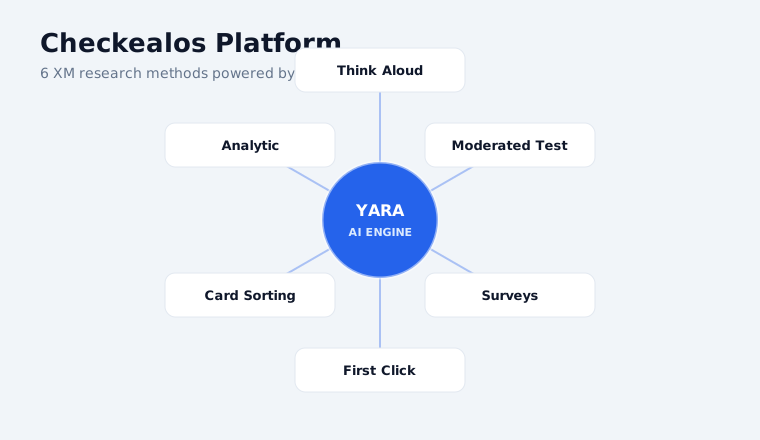
The platform
Studies, panel and analysis in one place.
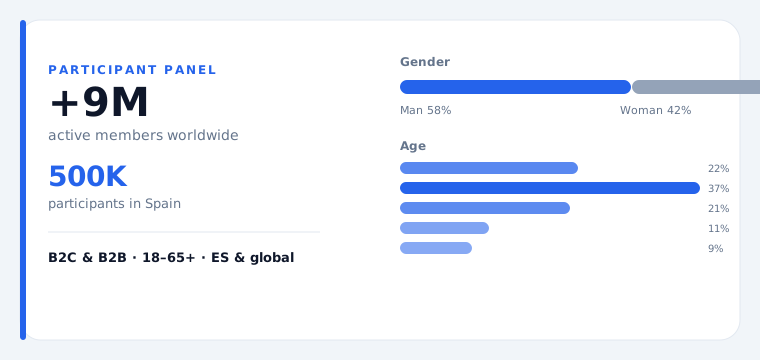
The panel
Qualified testers by country, language and profile.
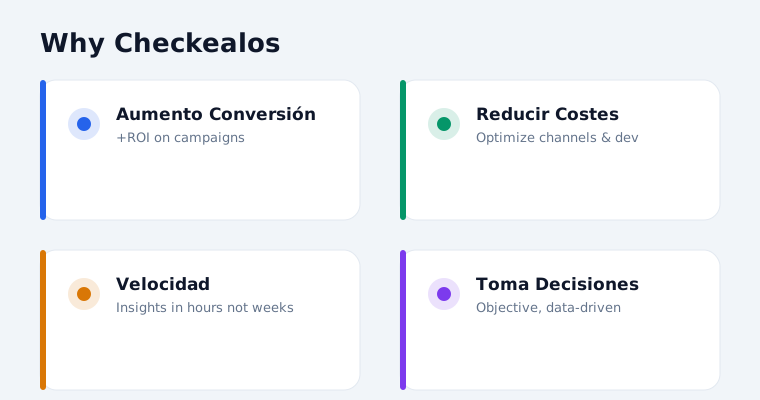
The results
Metrics comparable with your previous studies.
What is this template?
User retention and experience flow are the primary engines of digital business growth. This enterprise-grade diagnostic study is engineered to evaluate Feature Awareness and analyze identify customer and market awareness of your product
Purpose: Streamline conversion rates (CRO), improve task completion success, and reduce friction to boost corporate KPIs.
Why it matters in Customer Experience
In Customer Experience every touchpoint adds up or takes away. This kind of study connects the voice of the customer with business metrics (retention, NPS, revenue per customer) so decisions are evidence-based.
Problem it solves
Silent customer churn, high drop-off rates, poor feature adoption, and elevated customer support tickets.
Proposed solution
Deploy Checkealos behavioral video analytics and human-in-the-loop telemetry to identify and resolve visual and flow bottlenecks.
Study tasks
-
01
Step 1
Access the digital asset under a realistic, goal-driven user scenario.
-
02
Step 2
Execute the critical journey flow from end to end without assistance.
-
03
Step 3
Rate task difficulty (SEQ) and share qualitative insights via thinking-aloud.
How to prepare it
Briefing, sample and screening criteria
Briefing
Define the goal in one sentence before touching the template: which decision depends on this study. In Enterprise Audit & Optimization: Feature Awareness the goal is Streamline conversion rates (CRO), improve task completion success, and reduce friction to boost corporate KPIs. That sentence is the filter for everything else.
Muestra
For Unmoderated Usability Testing we recommend 40-60 participants and a duration of 15-25 minutes. In the Checkealos panel we recruit by country, language, device and professional profile, so your sample arrives pre-qualified.
Criterios
Write your screening criteria in positive form (who DOES fit) and negative form (who would contaminate the sample). Add one control question: if the participant fails it, the response stays out of the analysis.
How to analyse it
Metrics and how to read them
Metricas
This study returns: Task success rate, time on task, SUS, SEQ, drop-off. Every metric is computed the same way across all Unmoderated Usability Testing studies, so you can compare against your own history and against sector benchmarks.
Interpretar
Never read one metric in isolation: cross success with time and with perceived effort. High success with high effort means a flow that works only through sheer user stubbornness; low success with short times usually means an expectation problem, not a design problem.
Best practice and common mistakes
Best practice
- Run a pilot with 3-5 participants before opening the full sample.
- Write tasks as goals, not instructions (“get the receipt”, not “click the blue button”).
- Record a baseline metric before the change so you can measure the improvement.
- Keep the verbatim quotes: those are the ones that convince a board.
- Close the loop: share what changed after the study.
Common mistakes
- Asking for opinion instead of measuring behaviour.
- Recruiting colleagues as if they were real users.
- Changing several things at once and not knowing what worked.
- Leaving the sample open “until we have enough” and mixing waves.
- Shipping the report without a decision assigned to each finding.
Sample tasks and questions
Ready-to-copy examples for your study
Example 1
Access the digital asset under a realistic, goal-driven user scenario.
Example 2
Execute the critical journey flow from end to end without assistance.
Example 3
Rate task difficulty (SEQ) and share qualitative insights via thinking-aloud.
Use cases by department
Who uses this template inside the company
Customer Experience (CX)
Customer experience management
Customer support
Customer experience management
Marketing
Customer experience management
Sales
Customer experience management
Operations
Customer experience management
Cause & effect analysis
Cause: Complex navigation, hidden call-to-actions, or misleading UX copywriting. Effect: Poor user retention rates, decreased brand trust, and elevated customer acquisition cost (CAC).
Template data
Dimension
Customer Experience (CX)
Methodology
Unmoderated Usability Testing
Use case
Customer experience management
Department
Customer Experience (CX)
Category
Customer XM
What this template includes
Excel template
The study pre-built: tasks, screening criteria and metrics, ready to edit.
Session script
Instructions and script for the participant, aligned with the methodology.
Analysis template
Results dump with metrics computed and comparable.
Recruitment
Access to the tester panel by country, language and profile.
Related templates
Frequently asked questions
How many participants do I need?
For Unmoderated Usability Testing we recommend 40-60 participants. That is the point where the signal stabilises without inflating cost.
How long does the study take?
The session lasts 15-25 minutes per participant. Recruitment and field closure usually complete within 48-72 hours.
Can I use my own panel?
Yes. You can invite your own base or use the managed Checkealos panel; the template and the metrics are identical either way.
Which metrics will I get?
Task success rate, time on task, SUS, SEQ, drop-off. They are computed automatically and stay comparable with your previous studies.
Do I need a prototype or is the live product fine?
Both work. For Unmoderated Usability Testing what matters is that the participant can complete the task unassisted, in prototype or in production.
How does this fit the six dimensions?
This study sits in Customer Experience. Results feed the same data model as the other dimensions, so they can be crossed with what happens elsewhere.
Customise and launch this template
Edit the fields for your case and send it: we start recruitment.
Shall we run this study with your panel?
Download the template, adjust it and we will launch it with qualified testers.
Request a Demo