
How it looks in the platform
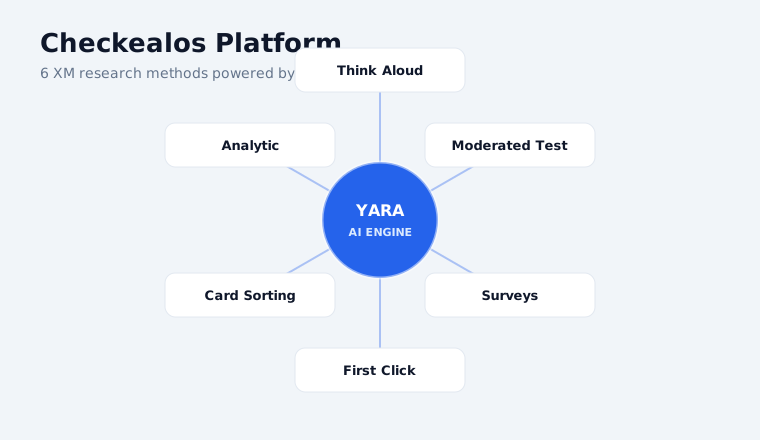
The platform
Studies, panel and analysis in one place.
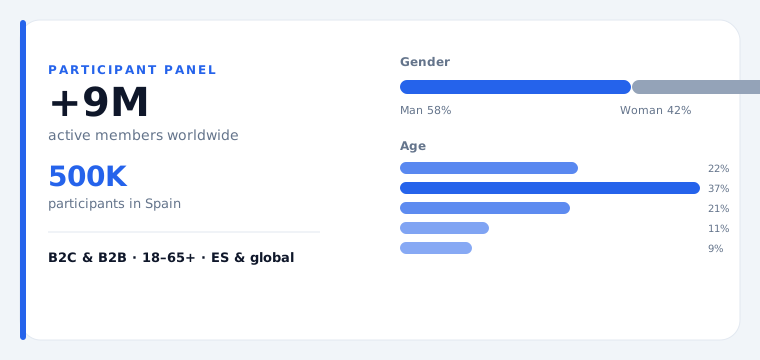
The panel
Qualified testers by country, language and profile.
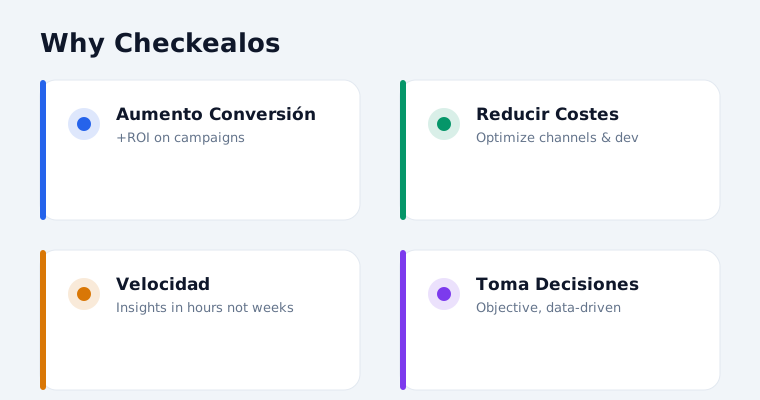
The results
Metrics comparable with your previous studies.
What you will get
METHODOLOGY: Quantitative Surveys / Questionnaires DIMENSION: CX (Customer Experience) USE CASE: Advertisement and creative testing DEPARTMENT: Customer Experience (CX) ANALYSIS: Statistical analysis + thematic coding OUTPUT: Actionable insights report with prioritized recommendations TEMPLATE: Optimizing Ad Testing: Creative Testing (Survey)
What is this template?
Customer Experience leaders use Optimizing Ad Testing: Creative Testing (Survey) to transform ad and creative testing from guesswork into data-driven decisions. The Quantitative Surveys / Questionnaires methodology provides a structured framework for Customer Experience teams to benchmark and improve outcomes.
Purpose: Enable Customer Experience to run a complete Quantitative Surveys / Questionnaires cycle on ad and creative testing, producing evidence-based recommendations and measurable outcomes.
Why it matters in Customer Experience
In Customer Experience every touchpoint adds up or takes away. This kind of study connects the voice of the customer with business metrics (retention, NPS, revenue per customer) so decisions are evidence-based.
Problem it solves
Customer Experience cannot prioritize improvements in ad and creative testing without data, causing budget waste and stakeholder frustration.
Proposed solution
Integrate Optimizing Ad Testing: Creative Testing (Survey) into your Customer Experience workflow. Customer Experience gains the ability to benchmark ad and creative testing, identify patterns, and act on insights in real time.
Study tasks
-
01
Step 1
Define target population and sampling frame for "Optimizing Ad Testing: Creative Testing (Survey)". Set quotas by role, tenure, and seniority.
-
02
Step 2
Design survey instrument: max 25 questions (Likert 1–7, open-ended, demographic). Pilot with 5 respondents from Customer Experience.
-
03
Step 3
Configure logic: randomize blocks, add skip logic, set soft-launch alert at 30% completion.
-
04
Step 4
Distribute via email + intranet. Set reminders at Day 3 and Day 7. Target ≥60% response rate in 10 days.
-
05
Step 5
Monitor dashboard: completion by segment, non-response bias flags, adjust ad and creative testing outreach.
-
06
Step 6
Close collection. Run cross-tabulation across Customer Experience segments and tenure cohorts.
-
07
Step 7
Thematic coding of open-ended responses: identify top 5 pain points and enablers for ad and creative testing.
-
08
Step 8
Deliver executive report: trending scores, priority matrix (impact vs. effort), 90-day roadmap.
How to prepare it
Briefing, sample and screening criteria
Briefing
Define the goal in one sentence before touching the template: which decision depends on this study. In Optimizing Ad Testing: Creative Testing (Survey) the goal is Enable Customer Experience to run a complete Quantitative Surveys / Questionnaires cycle on ad and creative testing, producing evidence-based recommendations and measurable outcomes. That sentence is the filter for everything else.
Muestra
For Quantitative Surveys / Questionnaires we recommend 200-400 participants and a duration of 5-10 minutes. In the Checkealos panel we recruit by country, language, device and professional profile, so your sample arrives pre-qualified.
Criterios
Write your screening criteria in positive form (who DOES fit) and negative form (who would contaminate the sample). Add one control question: if the participant fails it, the response stays out of the analysis.
How to analyse it
Metrics and how to read them
Metricas
This study returns: NPS, CSAT, CES, segment breakdown, response rate. Every metric is computed the same way across all Quantitative Surveys / Questionnaires studies, so you can compare against your own history and against sector benchmarks.
Interpretar
Never read one metric in isolation: cross success with time and with perceived effort. High success with high effort means a flow that works only through sheer user stubbornness; low success with short times usually means an expectation problem, not a design problem.
Best practice and common mistakes
Best practice
- Run a pilot with 3-5 participants before opening the full sample.
- Write tasks as goals, not instructions (“get the receipt”, not “click the blue button”).
- Record a baseline metric before the change so you can measure the improvement.
- Keep the verbatim quotes: those are the ones that convince a board.
- Close the loop: share what changed after the study.
Common mistakes
- Asking for opinion instead of measuring behaviour.
- Recruiting colleagues as if they were real users.
- Changing several things at once and not knowing what worked.
- Leaving the sample open “until we have enough” and mixing waves.
- Shipping the report without a decision assigned to each finding.
Sample tasks and questions
Ready-to-copy examples for your study
Example 1
Define target population and sampling frame for "Optimizing Ad Testing: Creative Testing (Survey)". Set quotas by role, tenure, and seniority.
Example 2
Design survey instrument: max 25 questions (Likert 1–7, open-ended, demographic). Pilot with 5 respondents from Customer Experience.
Example 3
Configure logic: randomize blocks, add skip logic, set soft-launch alert at 30% completion.
Example 4
Distribute via email + intranet. Set reminders at Day 3 and Day 7. Target ≥60% response rate in 10 days.
Use cases by department
Who uses this template inside the company
Customer Experience (CX)
Advertisement and creative testing
Customer support
Advertisement and creative testing
Marketing
Advertisement and creative testing
Sales
Advertisement and creative testing
Operations
Advertisement and creative testing
Cause & effect analysis
Cause: Siloed data on ad and creative testing across Customer Experience. Effect: No single view of truth, conflicting priorities, and slow response to emerging Customer Experience challenges.
Template data
Dimension
Customer Experience (CX)
Methodology
Quantitative Surveys / Questionnaires
Use case
Advertisement and creative testing
Department
Customer Experience (CX)
Category
CXM05: Digital Channel & Conversion Optimization
What this template includes
Excel template
The study pre-built: tasks, screening criteria and metrics, ready to edit.
Session script
Instructions and script for the participant, aligned with the methodology.
Analysis template
Results dump with metrics computed and comparable.
Recruitment
Access to the tester panel by country, language and profile.
Related templates
Frequently asked questions
How many participants do I need?
For Quantitative Surveys / Questionnaires we recommend 200-400 participants. That is the point where the signal stabilises without inflating cost.
How long does the study take?
The session lasts 5-10 minutes per participant. Recruitment and field closure usually complete within 48-72 hours.
Can I use my own panel?
Yes. You can invite your own base or use the managed Checkealos panel; the template and the metrics are identical either way.
Which metrics will I get?
NPS, CSAT, CES, segment breakdown, response rate. They are computed automatically and stay comparable with your previous studies.
Do I need a prototype or is the live product fine?
Both work. For Quantitative Surveys / Questionnaires what matters is that the participant can complete the task unassisted, in prototype or in production.
How does this fit the six dimensions?
This study sits in Customer Experience. Results feed the same data model as the other dimensions, so they can be crossed with what happens elsewhere.
Customise and launch this template
Edit the fields for your case and send it: we start recruitment.
Shall we run this study with your panel?
Download the template, adjust it and we will launch it with qualified testers.
Request a Demo